
Det Er Helt Texas!

The Norwegians have a hilarious saying when something crazy happens: “Det er helt Texas!” (That’s totally Texas!). The expression conjures an image of the lawless Wild West, awash with guns and gunslingers—which, we should note, was always a Hollywood fiction.
In Norway, unlike in the United States, it is uncommon to own a gun. Gun crime is rare. Owning a gun is not a societal norm in Europe the way it is in the US. Unless they are avid hunters, clay-pigeon shooters or die-hard criminals, Europeans generally don’t contemplate owning a gun. Guns are hard to come by and are heavily regulated.
Many Europeans find America’s gun culture baffling. Why, in a supposedly civilized society, are so many people allowed to own so many lethal weapons—not only small arms and shotguns but also military-grade rifles? Underlying America’s legendary friendliness and hospitality is there a helt Texas always on the verge of breaking out?
As a transplant from Europe in the 1990s, my response to the all-too-frequent news reports of mass shootings or gang violence was Euro-typical: the government should take away the guns. People can’t hurt each another as seriously or in such numbers if they can’t get their hands on a firearm. Indeed, Congress made several efforts to enact a permanent ban on military rifles, succeeding with a temporary one in 1994. When that ban expired ten years later, Congress, under intense pressure from the gun lobby, chose not to renew it.
My reflexive supportive of stringent gun control was a product of the culture I grew up in. I assumed that European society is more peaceful, or at least less violent, than American society because most people don’t own guns. This assumption belied the reality of daily life in the US, which felt very safe as long as one didn’t stray into the wrong neighborhood. Unlike in Europe, one wasn’t constantly on guard against such petty crimes as pickpocketing or mugging. And of course, the United States hadn’t suffered a major war in over 130 years, whereas Europe had been ravaged by two world wars during that time.
Was I suffering under a European misapprehension? Did America’s high but also highly localized rate of civilian gun violence obscure a deeper underlying social logic? Which bumper sticker was right: the one that said, “Guns don’t kill; people do” or the one that said “Guns don’t die; people do”?
The Second Amendment
Since its earliest days, America has been a land of guns. Gun ownership among white settlers in the British American Colonies was common. Males between sixteen and sixty were expected to have a musket at the ready in case of attack by Indians. The weapon also came in useful for hunting. Women and slaves were forbidden to own guns.
During the 18th century, as political tensions with Britain grew, colonial communities began forming militias. After Britain dispatched shiploads of redcoats to enforce various laws against which the American colonists chafed, the militias proliferated. With British troops stationed in New England and the two sides spiraling towards war, gun-owning men were expected to be ready and armed at a moment’s notice. These were the ‘minutemen’.
Britain’s attempt to control the colonies was doomed from the beginning. They were more than 3,000 miles away, they covered a vast area, and the resident populace was well armed, even if perhaps not as well-drilled as the redcoats.
After victory in the Revolutionary War, Americans feared that their newly-independent nation could be retaken by Britain at any time. Even after the new nation created a standing army in 1789, the tradition of civilian militias persisted. In fact, the value of civilian militias was perceived as so great in the face of the threat from across the Atlantic that it was enshrined in the Bill of Rights passed by Congress that same year and ratified in 1791, under the Second Amendment to the Constitution:
A well regulated militia, being necessary to the security of a free state, the right of the people to keep and bear arms, shall not be infringed.
In his 2014 book about the Amendment, Michael Waldman, a constitutional scholar at New York University School of Law, charts its course from a clumsily-worded legal text to the political hot potato it is today. It was, he points out, very much a product of its time. An earlier draft reveals some of the thinking that went into it.
A well-regulated militia, composed of the body of the People, being the best security of a free State, the right of the people to keep and bear arms, shall not be infringed, but no one religiously scrupulous of bearing arms, shall be compelled to render military service in person.
Translated into modern parlance, people should be allowed to own guns to fulfill their duties as members of a well-regulated militia, but membership of a militia is not required if one objects to it on conscientious grounds.
The draft also reveals certain differences in meaning between 18th-century language and modern language. For starters, the concept of a ‘well regulated’ militia in the 18th century did not imply institutional control as we would understand it but rather good discipline and internal balance: a militia, if you like, of the most committed men. The word ‘state’ in modern times tends to be taken as the federal state, yet Waldman points out that its use in the Constitutional text typically referred to the member states of the USA. It was thus up to individual states to form militias.
Some of the amendment’s wording was never clarified. Is the “body of the People” the body politic, as the Framers used the term, or the collection of all individual persons? This question muddles the meaning of “the right of the People”: what right are we talking about?
Only the part about bearing arms is clear. “The militia required an armed citizenry,” Waldman writes. “[M]ilitia members were expected to own a military gun. It was not just a military draft … but a requirement to be armed for the good of the community. That was understood, and assumed.”[1]
When the draft went to the Senate for ratification, the senators stripped out the parts about the body of the People and conscientious objection. “We do not know why these changes were made,” writes Waldman, although, he notes, they gave Congress leeway to determine who would serve, and in what kind of militia.[2]
In spite of the amendment’s “foggy wording and odd locution,” its commas and clauses endlessly debated by legal scholars, the case law that emerged over the ensuing two hundred years was remarkably consistent. “Judges overwhelmingly concluded that the amendment authorized states to form militias—what we now call the National Guard,” writes Waldman. Yet that same foggy wording spawned endless debates (and volumes of case law) on what it means to “not infringe the right to bear arms”. Finally, in 2008, “the US Supreme Court upended two centuries of precedent. In the case of District of Columbia v. Heller, an opinion written by Justice Antonin Scalia declared that the Constitution confers the right to own a gun for delf-defense in the home.”[3]
Ironically, Scalia was an originalist. One would have expected him to hew to the original meaning and intent of the Second Amendment. Instead, he reinterpreted it within the context of modern-day America. To the Framers, the right to own a gun was for the express purpose of serving in a militia.[4] Yet after the Treaty of Ghent in 1814, British aggression ceased to be a concern to the United States: so, in the absence of anyone else trying to invade, any earlier justification for civilian militias evaporated. Yet there it remained in black and white: the constitutional right to “keep and bear arms” over which successive generations of gun-rights and gun-control advocates argued.
The United States is the only country in the world with a broadly defined right of this kind baked into its constitution. A handful of countries, including Mexico, Guatemala and Haiti, grant a constitutional right to own a gun in the home but (at least in theory) guns in those countries are more heavily regulated than in the US. A larger number of other countries have a legal tradition of gun ownership for self-defense or for militia service but no explicit constitutional right.
Gun country
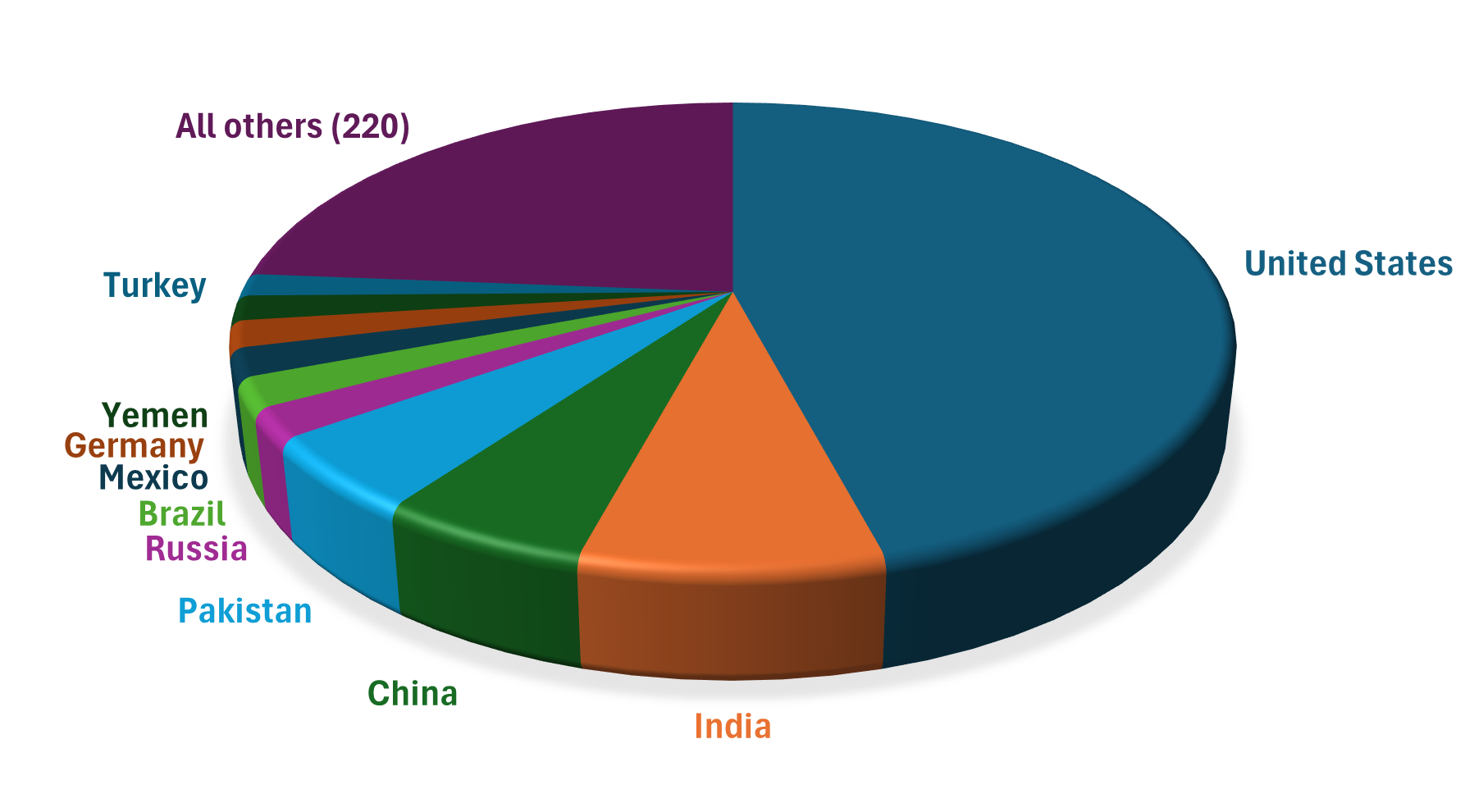
As the population of the United States ballooned during the 19th and 20th centuries, so did the number of guns. By the early 21st century, according to a 2017 study by the Small Arms Survey, a Geneva-based nonprofit, just over a billion firearms existed worldwide, of which around forty percent resided in the United States. Of these, the vast majority (85%) are civilian firearms, with about two percent in the hands of law enforcement and the remainder in the military.[5]
As Figure 1 shows, the United States accounts for about 46 percent of the world’s civilian firearms.
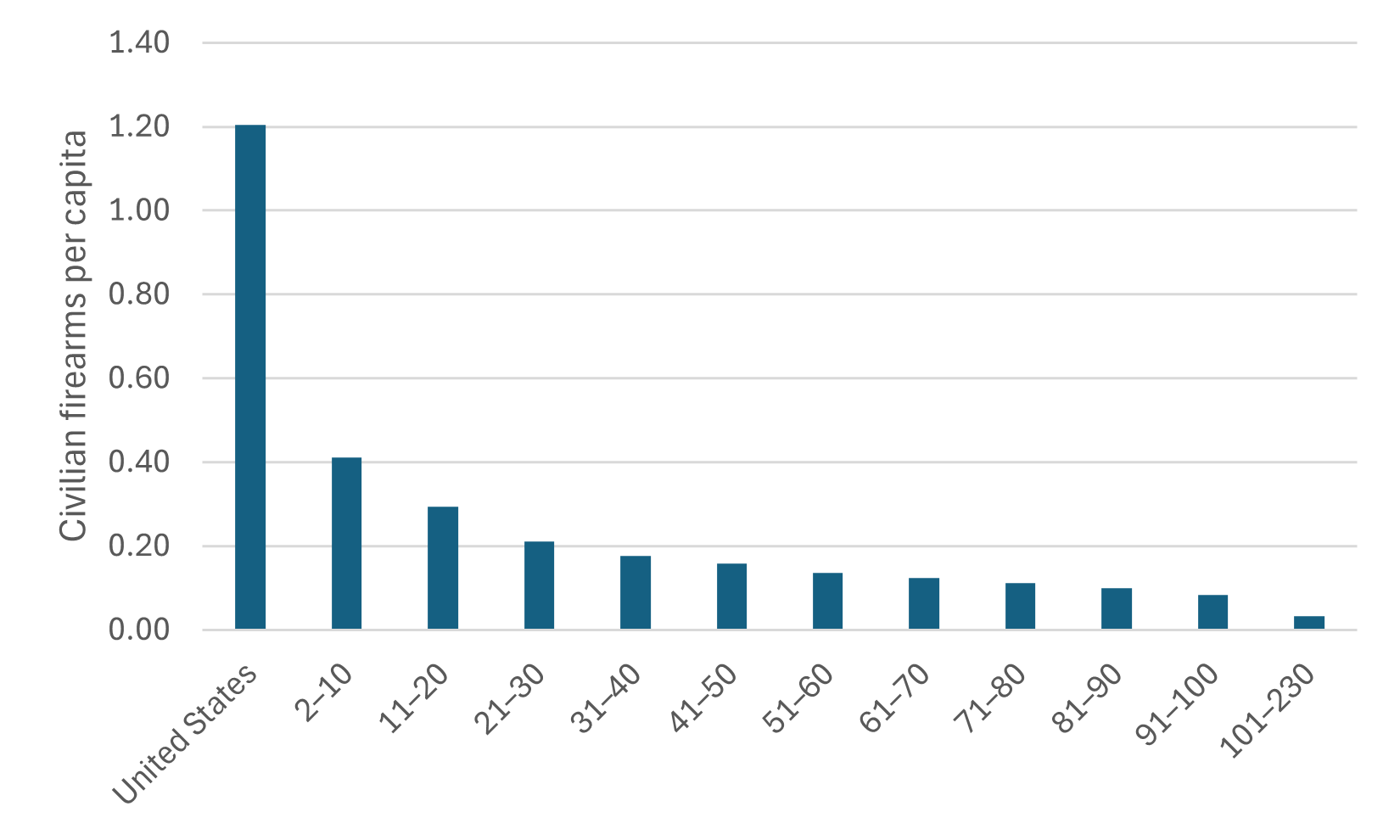
Yet Americans make up only 4 percent of the global population. On a per-capita basis, American gun ownership really stands out. In 2017, the US was home to 393 million civilian guns and 326 million people. That’s 1.2 firearms for every American resident (Figure 2).
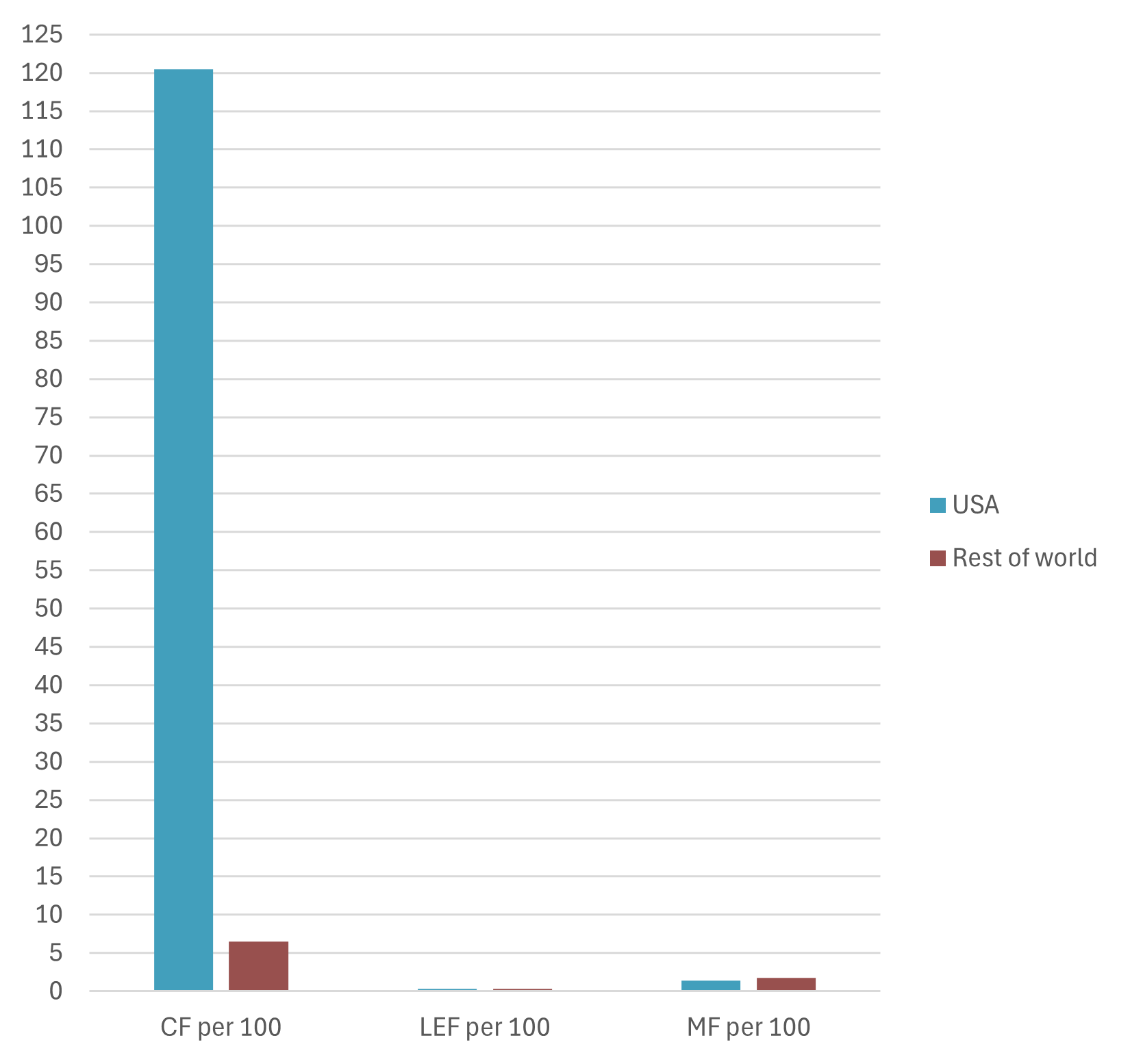
Also noteworthy is the per-capita distribution of guns. In this regard, the United States is an outlier as well. Over 98 percent of its guns are in civilian hands, compared with about 75 percent in the rest of the world. Conversely, almost 21 percent of guns in the rest of the world are military, whereas the American proportion is only 1.1 percent (Figure 3).
However you look at it, America is gun country.
Er USA helt Texas?
But is it totally Texas? Is the disproportionate concentration of firearms in the US reflected in disproportionate rates of gun violence or gun crime?
Conveniently, the Small Arms Survey publishes a database of violent deaths by country in various categories, including intentional and unintentional homicides by firearms. Across countries, these types of gun death do not correlate with rates of firearm ownership. Gun ownership is an equally poor predictor of all homicides, by guns or otherwise. The data are scattershot, even if one removes the United States as an outlier.
What about crime in general? Although consistent data across countries are hard to come by, a nonparametric crime index published by numbeo.com, based on online surveys, shows a very weak negative correlation with gun ownership rates, which might be a statistical artifact.[7]
Where a strong correlation exists is between general crime rates and gun homicides. Across countries, rates of gun homicide can explain about 50 percent of the variance in the crime index.[8] This result implies that societal factors rather than gun ownership are probably responsible: crime-ridden countries are liable to have higher rates of gun deaths, irrespective of the prevalence of guns.
By way of illustration, the United States’ crime index, on a scale of zero to 100, is 48.8, neither high nor low. Its rate of gun homicides is 0.51 per 100,000 people per year, which is higher than most countries but still only one-tenth of the deadliest ones, El Salvador and Venezuela. A country awash with guns is not, in and of itself, a lawless country, but countries where the law is weak will be at higher risk of gun violence.
Even so, the United States’ relatively high rate of gun homicides is partially explicable by people’s ready access to guns. Compare it with such countries as Afghanistan, Papua New Guinea, South Africa and South Sudan, all of which rank very near the top of the general crime index but have much lower gun homicide rates, probably because most people simply can’t get their hands on a gun.
If the USA is not particularly ‘Texas’, are certain parts of the USA more ‘Texas’ than others, and if so, why? When we look inside the United States, we find that that the rate of gun ownership plays a more important role.
A recent analysis by the Center for American Progress finds that the highest rates of gun homicides are found in rural counties.[9] That study draws upon county-level data collected by the Centers for Disease Control (CDC). Using the same data, I found that gun homicides show a strong negative correlation with population density[10] across 411 counties reporting at least one gun homicide between 2018 and 2024.[11]
Do less populated counties have more or fewer guns per capita? Unfortunately, rates of gun ownership by county are extremely spotty—in part due to certain Second Amendment rights enshrined in federal legislation and case law, the most notable being a federal prohibition on a national gun registry. This is a shame for us data nerds because America’s roughly 3100 counties provide a nicely fine-grained picture of population density. Aggregating up to the state level muddies the waters a little because many states with middling population density—such as Texas—have several large urban areas surrounded by numerous thinly-populated rural counties. But this aggregation has to be done because the only reliable estimates of gun ownership are at the state level, such as a recent one by the RAND Corporation.[12]
Nonetheless, a correlation emerges. Although there is a weak negative correlation between gun deaths and population density at the state level, the RAND data show a very strong negative relationship between gun ownership and population density These combine to produce a strong positive correlation between gun deaths and gun ownership.[13]
This means that the most guns per capita are in the least populated areas, and also that these areas have the highest rates of gun deaths. If someone in a rural area wants to harm themselves or another, they’re much more likely than an urbanite to have a gun within easy reach to do the deed.
That said, it is also true that urban counties have higher absolute numbers of gun deaths than rural ones. For instance, Los Angeles county averaged about 155 gun homicides each year from 2018 to 2023. But LA County holds 10 million people, which is more than the entire populations of the three states (Oklahoma, Maine and Oregon) having the highest rates of gun deaths. Their combined total over the same period averaged 1115 such deaths. Which is safer: the city or the country? It depends how you look at it.
Either way, a lot of people in the US die from gunshots, and in this regard America is helt Texas. How could it be made less Texas and more, say, Denmark, without angering millions of responsible gun owners?
From my cold, dead hands
Michael Waldman provides an entertaining account of the tug-of-war over the Second Amendment, which began in the 19th century and eventually gave birth to the gun lobby as we know it today. A hundred years ago, the National Rifle Association was a sleepy, politically reticent enthusiasts’ club which, if it took a position on anything, promoted responsible gun ownership. Yet in the face of spiraling urban violence in the 1960s and ’70s, the NRA became a more vocal defender of gun rights, not because it identified with inner-city gang-bangers—far from it—but because its members resented what they perceived as heavy-handed attempts by government to punish all gun owners. Law-abiding hunters and sportspeople felt it was unfair that they should be tarred with the same brush as violent criminals, even though in general lawmakers took pains to distinguish between the two in their deliberations.
Over time, the NRA’s rhetoric became more militant and fiery, the Second Amendment more and more of a political crutch divorced from legal reality, so that by the early 2000s, the NRA had mutated into a macho-performative lobbying powerhouse, intent on ending the career of any legislator who stood in its way. Its annual meetings took on the feel of political rallies, with its charismatic president, the former actor Charlton Heston, bellowing into the microphone at the beginning of his every speech: “From my cold, dead hands!”
The first ever gun control legislation passed in the United States was the National Firearms Act of 1934. It formed part of an effort by the Roosevelt administration to rein in the gangsters of the Prohibition era. Machine guns and sawn-off shotguns had to be registered, could not be transported across state lines, and were heavily taxed. The NRA supported the bill.
In 1968, following the assassinations of Martin Luther King Jr. and Robert F. Kennedy, Congress passed the Gun Control Act, which established federal licensing for gun dealers and banned the import of military-style weapons. Later, under President Bill Clinton, Congress passed the Brady Bill, which enshrined background checks and a waiting period for firearms purchases, along with a separate ban on assault weapons. Clinton tried to appease law-abiding gun-owners, assuring them that “not a single hunter in America has lost a weapon or missed a season as a result” of the bill; but many gun owners, perhaps fueled by the gun lobby’s fearmongering, didn’t want to listen. The mistrust of government ran too deep.[14]
As Waldman chronicles, the expiration of the assault weapons ban in 2004 opened the door to a number of other developments. First was a law signed by President George W. Bush in 2005 to immunize gun manufacturers and sellers from lawsuits. In the same year, Florida’s Stand Your Ground law permitted individuals to use deadly force if they felt threatened. The Heller Supreme Court case in 2008 struck down the District of Columbia’s gun law on the grounds that it violated the majority’s interpretation of the Second Amendment.[15] Then, in 2012, there was Sandy Hook; in 2017, Las Vegas; and in 2018, Parkland. Deadly gun rampages had been steadily increasing all the while, from four in 2004 to 27 in 2018.[16] Fifty-five percent of the perpetrators were white and 95 percent were male.[17]
Guns as vehicles … sort of
Could the government have done things differently, to take the heat out of the debate? Could it have crafted legislation that reduces the gun to the status of any other widely used technology which, if improperly used, poses a risk to life and limb? Can a system be devised to keep the baddest guns out of the wrongest hands while not penalizing law-abiding gun owners?
Former Chief Justice Warren Burger was onto something in a 1991 TV interview on Jim Lehrer’s News Hour when he argued that “If the militia … was going to be regulated, why shouldn’t [gun owners] be regulated in the use of arms the way an automobile is regulated?”[18]
Automobile safety regulations are mostly mundane and hardly controversial. There was a fuss for a while in the 1960s when the seat belt law came into effect, but that law was not even widely enforced until the 1980s. Along the same lines, many states have helmet laws for motorcyclists. These laws present little to no inconvenience to vehicle users while reducing burdens on emergency responders and lowering overall healthcare costs.
In the years since Burger made his case, a few writers have taken up the theme, some arguing in favor of it, others against it.[19] Most of these arguments focused on direct regulation, in the sense of checks, restrictions and, if necessary, bans.
I would like to take a slightly different approach, wearing an economist’s hat. Vehicle regulation is a starting-point but not a perfect template for firearm regulation. Instead, an insurance market for firearms, under a light regulatory touch, could accomplish much of what heavy-handed government regulation failed to.
Let’s briefly review the steps one has to take to buy and own a car. First, you have to obtain a driver’s license, which necessitates studying for, and taking, a test. You need to know the rules of the road and you need to demonstrate competency and safety behind the wheel. Once you are licensed by your home state to drive, you can purchase the vehicle of your choice. At purchase, the state registers the vehicle in your name or, if leased, in the lessor’s name. The registration connects the vehicle’s license plate to the current owner. The state also requires all drivers to carry insurance, which one obtains through any number of private companies. All US states follow the same system and all documentation from one state is valid in all the others.
If requested by an officer of the law, a driver is required to present the three documents in question: driver’s license, registration and proof of insurance. Failure to provide any one of these can result in prosecution.
This system ensures that the overwhelming majority of vehicle trips pass without incident. It works well and is uncontroversial. Most vehicle owners, most of the time, are careful and law-abiding.
It is surely also the case that most gun owners are careful and law-abiding, and most instances of firearm use pass without incident. What is missing for firearms is what exists for vehicles, which is a system of deterrents and punishments for reckless use, whether excessive speed, driving under the influence, causing a collision, or—worst of all—vehicular manslaughter.
Some of these deterrents are regulatory and others are market-based. Vehicle licenses and registrations are regulated by the state. A license is granted contingent on the safe use of a vehicle, and may be suspended or revoked if a driver’s behavior is found sufficiently reckless. A registration requires an annual fee paid to the state which scales according to the value of the vehicle: newer, fancier cars cost more to register than older, more basic ones. Insurance, on the other hand, is market-based, with insurance costs scaling according to many factors, among them the value of the car, where and how it is kept, the risk profile of the driver, and competition among insurers for customers.
At face value, it might be tempting to simply propose a sales tax on new firearms that scales with the lethal potential of the weapon. That way, only the wealthy could afford the deadliest assault rifles. Mass murders, after all, are not generally committed by rich people. Conversely, any angry young man of average means would be priced out of the market for those weapons.
The problem is that the tax would price everyone else of average means out of the same market, which would be unfair. The gun-control advocate might say, “Good! Those weapons shouldn’t be in civilian hands anyway.” But the tax would have to be a federal one because most states, left to their own devices, wouldn’t implement it. By rendering the deadliest weapons very expensive, the government could offer an inducement to existing owners to purchase their weapons at some percentage of the value of new ones. Some owners, faced with an offer of perhaps tens of thousands of dollars for their AR-15, would take the deal. Many of the more die-hard ones would simply reply “from my cold, dead hands.”
Even if the tax revenue covered the cost of the buyback, this idea feels like a non-starter politically. A tax cannot render the most lethal kinds of weapons as rare as the most expensive cars. And what is true of cars is also true of guns, that the lethality of the instrument in any particular instance depends on the individual handling it. Someone determined to commit murder would likely choose the weapon best suited for the task: a handgun for close quarters, a rifle for a sniper job, or an assault weapon for maximum carnage.
The insurance requirement, however, is a market-based prescription. It creates a natural incentive toward safety and risk-aversion. A driver found at fault in a collision will see their premiums increase. Insurance companies are in the business of devising actuarial methods and other processes to establish their rates, or to deny service altogether to risky individuals. Our proverbial angry young man might have the means to acquire a pistol or even a military-style rifle, but he might find himself unable to insure it, whether due to his age, profile, or any background checks the insurance company might run on him.
A law requiring insurance could incorporate a provision instructing insurance companies to include in their due diligence not only background checks but also any other records that could identify a high-risk individual. State requirements for training, licensing and registration might not catch someone who is technically competent but psychologically deficient. Insurance companies have an incentive to identify such individuals because of the actuarial risk they pose.
The cost of insurance also would scale with the actuarial risk of the weapon itself. Assault weapons would cost more to insure than handguns. It might seem as if requiring all gun owners to pay for registration and insurance would penalize law-abiding gun owners, but it is also likely that they would welcome the requirement for the same reason that safe drivers enjoy peace of mind from being insured. Although insurance carries a cost, it also—by definition—ensures a payout in the event of an accident or an assault.
Gun insurance would furthermore provide a ready-made conduit for compensating the victims of gun crime—whether they were gun owners or not—similar to the compensation auto insurance provides to cyclists and pedestrians injured by cars.
Along with licensing and registration, an insurance requirement would be instituted at the state level. If successful, the system might be replicated state by state until sufficient support grew for an Act of Congress.
Obviously, the system would not be failsafe. There are plenty of drivers out there who do not carry a valid license, current registration or insurance. They run a risk every time they hit the road, and a much greater one if they hit another vehicle. A similar system for firearms would not keep guns out of the hands of every miscreant. It might not diminish the rate of gun suicides. It might not curtail by very much the incidence of gun homicides in the home, many of which are crimes of passion. But it would reduce the frequency with which headlines about yet another mass shooting are splashed across our screens, about which Europeans roll their eyes and complain how America is still the Wild West. And it would most likely result in lower rates of gun violence overall.
Implemented at the state level, the system would not run afoul of federal law. There is no federal prohibition on state firearms registries, only on a federal one.[20] And what with insurance companies operating in many states, they would have access to multiple state registries at once, thereby pooling them.
A system like this also would be Second Amendment-compatible. The Heller ruling, whether one agrees with its interpretation of the amendment or not, established a right for gun ownership in the home. People’s right to own vehicles is uncontested, requiring no constitutional protection, and yet vehicles in all states must be licensed, registered and insured.
Some surprising benefits … and not-so-surprising risks
Since a sales tax is unlikely to render an AR-15 as rare as a Bugatti, it’s fair to say that the 400 million guns in private hands will remain there—unless or until a sea-change in social norms were to prompt a revision or repeal of the Second Amendment, along with legislation along the lines of Australia’s National Firearms Agreement, which took around 650,000 assault weapons out of circulation after a 1996 massacre at Port Arthur in Tasmania.[21]
Given this reality, an American system of licensing, registration and insurance would accomplish at least part of what Australians accomplished in 1996 “for the greater common good,” to use Prime Minister John Howard’s words.[22]
As a long-time transplant from Europe, I have come to accept the reality of America’s relationship with guns, even if I still don’t really understand its gun culture. Although an idealized America, in my mind, would be firearm-averse, I have also come to accept that certain benefits accrue to having a well-armed citizenry.
For one thing, the USA can never be invaded by a foreign power. Not only are its geographical isolation and the scale of its military major impediments to invasion but also just imagine what a foreign army would encounter if it were actually able to land on American shores or parachute into America’s heartland. Three hundred and thirty million people armed with 400 million guns, all probably ready and willing to fight to the last bullet. Geopolitically, the United States is as safe as houses—something not all American leaders appreciate when they deal with our democratic allies.
Another, less obvious benefit of a well-armed citizenry is its deterrence to a threat from within.
The aspiring dictator currently in the White House speaks frequently about those opposed to him as a ‘threat from within’. Eliminating this threat, he believes, will smooth his path to outright dictatorship. But it takes one to know one: the language dictators use to describe their enemies often apply to themselves. To a democracy, the dictator himself is a threat from within.
A dictator will never succeed in taking over a country unless a majority of people either want him to or don’t stand in his way. If a majority of Americans who value the freedom to own guns also value their constitutionally guaranteed freedom of association, freedom of speech, freedom of worship, and freedom of elections then, if or when they realize that the dictator is taking those things away, they will do to him what the Revolutionaries did to the British. No military force under his command would be able—or indeed probably willing—to stand in their way.
On the other hand, if an aspiring autocrat successfully turned Americans against one another in a form of ‘us versus them’ otherism, they would do to each another what they did in the 1860s. A second civil war should be avoidable but in the current climate it is a worry, especially in a country with 400 million guns.
A divided America awash with guns is somewhat analogous to the Cold War world of the late 20th century: two superpowers maintaining an uneasy peace through mutual risk-aversion. Not a particularly stable or sustainable state of affairs for the long term but at least not mutual annihilation. That would be helt Texas.
Works cited
Australian Department of Home Affairs (2017) National Firearms Agreement, updated. www.homeaffairs.gov.au/criminal-justice/files/national-firearms-agreement.pdf.
Australian Parliamentary Education Office (no date) National Firearms Agreement. https://peo.gov.au/understand-our-parliament/history-of-parliament/history-milestones/australian-parliament-history-timeline/events/national-firearms-agreement.
Centers for Disease Control (no date) Provisional Mortality Statistics. CDC WONDER Database. https://wonder.cdc.gov/controller/datarequest/D176.
Conover, C. (2015) Should guns be regulated like cars? Forbes, Sep 01, 2015. https://www.forbes.com/sites/realspin/2015/09/01/should-guns-be-regulated-like-cars/.
FBI (no date) Quick Look: 277 active shooter incidents in the United States from 2000 to 2018. Federal Bureau of Investigation. https://www.fbi.gov/how-we-can-help-you/active-shooter-safety-resources/active-shooter-incidents-graphics.
Hall, C. (2025) The highest rates of gun homicides are in rural counties. Center for American Progress, Sep 26, 2025. https://www.americanprogress.org/article/the-highest-rates-of-gun-homicides-are-in-rural-counties/.
Kristof, N. (2014) Our blind spot about guns. New York Times, July 30, 2014. https://www.nytimes.com/2014/07/31/opinion/nicholas-kristof-our-blind-spot-about-guns.html.
Martin, S. and A. Bogle (2025) Australia was once the gold standard for gun safety. Experts say it’s losing control. The Guardian, 24 Aug 2025. https://www.theguardian.com/australia-news/2025/aug/25/australia-was-once-the-gold-standard-for-gun-safety-experts-say-its-losing-control.
Numbeo.com (no date) Crime Index by Country, 2017. https://www.numbeo.com/crime/rankings_by_country.jsp?title=2017&displayColumn=0.
RAND Corporation (2020) State-Level Estimates of Household Firearm Ownership. RAND Corporation, Santa Monica, CA. https://www.rand.org/pubs/tools/TL354.html.
Rockefeller Institute of Government (no date) Mass Shooting Factsheet. State University of New York, https://rockinst.org/gun-violence/mass-shooting-factsheet/.
Small Arms Survey (2017) Global Firearms Holdings. Small Arms Survey, Geneva, Switzerland. https://www.smallarmssurvey.org/database/global-firearms-holdings.
Small Arms Survey (no date) Global Violent Deaths (GVD) database 2004-2021, 2023 update, version 1.0. https://zenodo.org/records/8215006.
US Census Bureau (no date) Geographic information for all counties, 2020. https://data.census.gov/table?g=010XX00US$0500000&y=2020&d=GEO+Geography+Information.
Waldman, M. (2014) The Second Amendment: A Biography. Simon & Schuster, New York.
[1] Waldman (2014) pp. 61–64.
[2] Waldman (2014) pp. 56–57.
[3] Waldman (2014) p. XII.
[4] Waldman (2014) pp. XII–XIII.
[5] The Global Firearms holdings study used three principal methods for arriving at firearms totals: (1) actual reported holdings, (2) estimates based on the size of law enforcement agencies or militaries, and (3) estimates based on population. Although totals for many countries were estimated, there were a sufficient number of actual totals for the global totals to be a reasonable approximation.
[6] Countries and regions for which civilian firearms counts were available numbered 227. For law enforcement, the number was 225. For military guns, the number of countries was 171.
[7] The index is based on online surveys of people’s perceptions of crime levels in various categories and the severity of those crimes, which could introduce a degree of statistical bias. On the other hand, these statistics do not suffer from inconsistency, data gaps or bias across governmental reports of actual crime rates. See https://www.numbeo.com/crime/indices_explained.jsp for a description of the assumptions and method.
[8] Pearson correlation coefficient, r = 0.50, degrees of freedom (df) = 216, paired t-statistic = 8.6.
[9] Hall (2025)
[10] County populations are from the CDC dataset; county land areas are from the US Census Bureau.
[11] Out of 3142 counties in the dataset, many had zero gun homicides in these years. The data for numerous others reporting less than 10 gun homicides per year were suppressed by the CDC for privacy reasons. Using the logarithms of the non-zero data (which are lognormally distributed), r = –0.524 and t = –12.4 on 410 degrees of freedom.
[12] RAND Corporation (2020). This study estimates an average of reported gun ownership by adults, from various sources described in the report and associated dataset.
[13] Gun deaths v population density by state (aggregated from county level): r = –0.216, df = 49, t = –1.53. Gun ownership (RAND) v population density by state: r = –0.802, df = 49, t = –9.30. Gun deaths v gun ownership by state: r = 0.499, df = 49, t = 3.99.
[14] Waldman (2014) ch. 4.
[15] Waldman (2014) chs. 7, 8.
[16] Federal Bureau of Investigation.
[17] Rockefeller Institute of Government.
[18] Waldman (2014) pp. 84–85.
[19] Kristof (2014); Conover (2015).
[20] The Firearms Owners’ Protection Act (FOPA) of 1986.
[21] Australian Parliamentary Education Office and Department of Home Affairs.
[22] Martin and Bogle (2025).
The gun problem in the United States is a symptom of the deeper disease of Neoliberal financialization that has infected our economy and society through the wrong turning of fiduciary practice into the financial mathematics of securities trading through the false promise of Modern Portfolio Theory that happened in the early 1970s, and the missed opportunity to turn away from securities trading and back towards Prudent Stewardship that was not taken in the 1980s.
The opportunity is still there, to right that wrong.